October 7, 2026
Peptide Purity Analysis Solution
By @sergioszoc143
Peptide Screening: Hplc & Mass Specification Purity Overview Peak
Explore our brochure to check out validated research study substances and learn more regarding our screening and quality assurance process. Even small pollutants can alter results, lower reproducibility, or present unwanted variables into a research. Scientists depend upon precise, confirmed compounds to ensure their findings are both legitimate and consistent.Peptide Practical Analysis In Biomedical Study
- One of the most rigid grade, including mindful HPLC filtration-- occasionally several rounds-- and extensive QC.
- Measuring peptide purity is typically made with logical high-performance fluid chromatography (HPLC), commonly combined with mass spectrometry (MS) for identification confirmation.
- HPLC procedures chromatographic purity by dividing the target peptide from relevant impurities and computing main-peak location percent.
- This technique separates peptides from impurities and evaluates both target peptides and pollutants, making certain top notch samples for research study.
- It's possible to have a peptide that is, state, 95% pure by HPLC and yet the internet peptide material is something like 70% of the powder's weight (the remainder being water and salts).
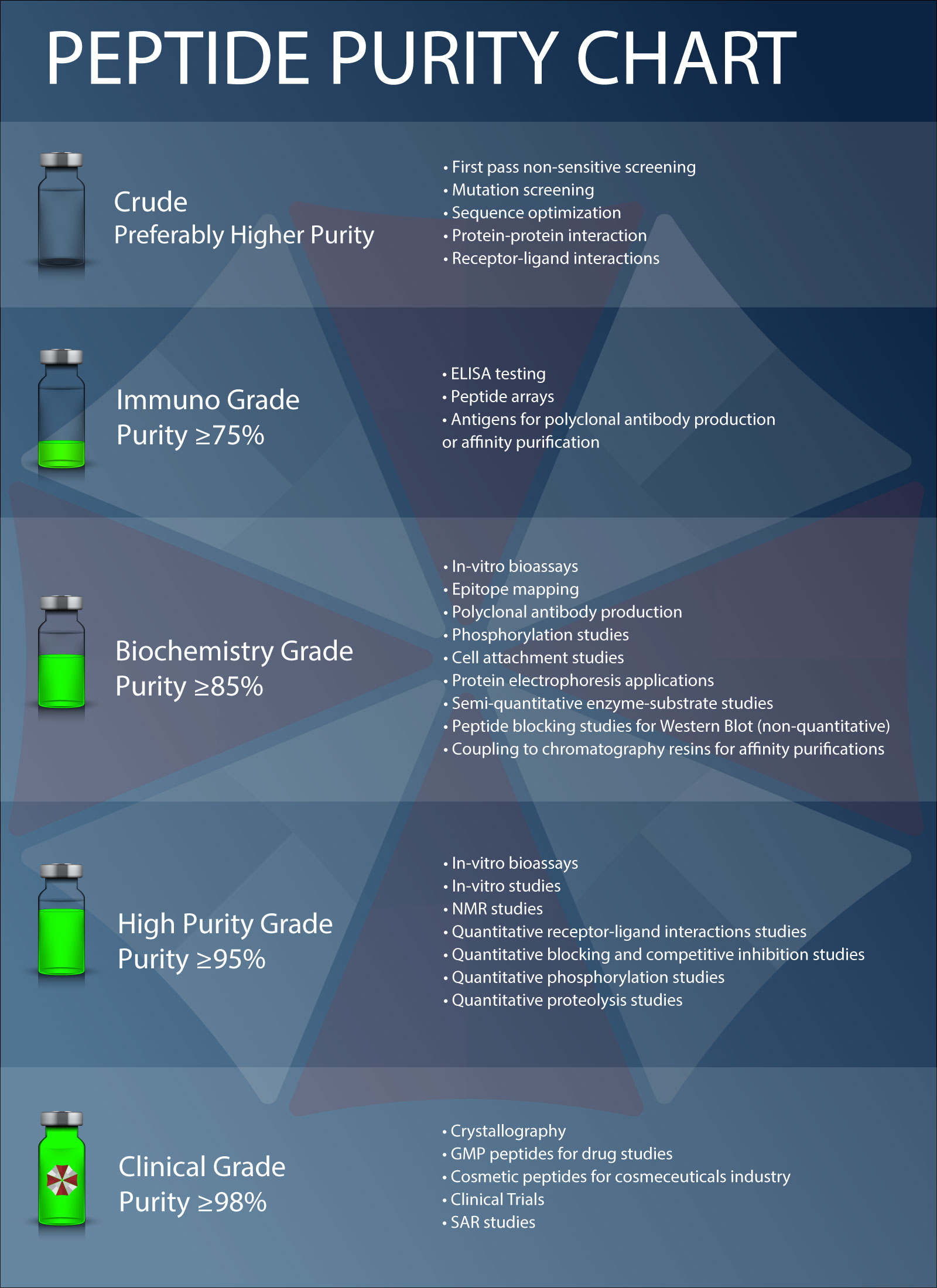
The purity of peptides is commonly examined making use of high-performance liquid chromatography (HPLC). HPLC divides peptides based upon their communications with a stationary phase, enabling pollutants and byproducts to be recognized and evaluated. Additionally, mass spectrometry (MS) can be used to verify the peptide's molecular weight and sequence, providing more confirmation of purity by detecting pollutants and deterioration products. If you have actually ever gotten an artificial peptide for a lab experiment, you have actually likely noticed a pureness percent on the certificate of analysis-- normally values like 95%, 98%, or even 99%. Peptide purity is a vital quality metric that informs you what fraction of a peptide sample is the desired product versus undesirable by-products.
While peptide purity isn't the only variable, making use of improperly characterized reagents is a recognized contributor to irreproducible outcomes. For a 10-residue peptide with 99.5% combining efficiency, you 'd expect concerning 95% of the final product to be the full-length series prior to filtration. For a 30-residue peptide at the same efficiency, that goes down Check out the post right here to roughly 86%. This is why longer peptides are more challenging to create at high purity and usually set you back even more. Pureness is the portion of books in the delivery that have every page printed properly, in the right order, without any missing out on phases and no additional pages stuffed in. A 95% purity indicates that out of every 100 "books" Peptide Vendor in your set, 95 are best copies and 5 have some sort of mistake.
Research Uses Peptide Chemical & Physical Analyses
BOC Sciences uses multi-batch contrast evaluation to aid customers develop raw material top quality criteria and make certain uniformity. Recurring non-peptide parts can transform assay interpretation, misshape peptide content computations, and make complex great deal qualification. We support targeted evaluation of appropriate residuals based upon the project and example background.
Unlike a supplier's internal screening, independent third-party laboratory validation is objective and gives impartial results, adding reliability via unbiased logical information. This process is crucial for preserving high peptide top quality since the peptide market is mainly unregulated in several locations, and without recognition some suppliers might use impure, mislabeled, or even phony peptides [3] Guaranteeing that each batch undergoes correct laboratory screening aids validate the peptide's authenticity and purity, which is important for both research validity and safety. Peptide purity describes the percentage of your sample that is the proper, unabridged peptide sequence, free from other peptide-related impurities. For example, a pureness of 98% shows that 98% of the peptide product is the designated product, while the other 2% could be undesirable residues of synthesis (such as insufficient sequences or amino acid deletion variations). 
❧